
South Carolina Death Index
The South Carolina Death Index is the starting point for anyone searching death records in the Palmetto State. Maintained by the SC Department of Public Health, the death index covers deaths registered statewide beginning January 1, 1915. You can search the death index online, by mail, or in person at the state vital records office in Columbia. Whether you need a certified death certificate for legal purposes or are conducting genealogical research, this guide walks you through the resources, offices, and steps for finding South Carolina death records.
South Carolina Death Index Quick Facts
Searching the South Carolina Death Index
South Carolina began statewide death registration on January 1, 1915. General compliance across all counties was achieved by 1918. Two cities kept earlier local records: Charleston has death records going back to 1821, and Georgetown has records beginning in 1883. For any death from 1915 forward, the state death index is the best place to start. The SC Department of Public Health Vital Records office holds all statewide death records and manages both the index and the underlying certificates.
The SC DPH has published death index log files covering 1915 through 1967 as downloadable files organized by year range. These files are segmented into 1915-1924, 1925-1934, 1935-1944, 1945-1949, and 1950-1961, with 1950 and later data available in a searchable digital format. Records from 1915 through 1949 are available as scanned images of the original index cards. Each index entry typically shows the decedent's name, date of death, county of death, and the state file number. That file number is what you need when ordering the actual certificate.
The SC DPH website provides free access to the death index database. Researchers can browse death indexes from 1915 through 1967 without any fee. For deaths after 1967, you will need to contact the Vital Records office directly to confirm whether a death record exists before placing an order.
The online index is the fastest way to confirm a death occurred and find the state file number. Once you have that number, ordering the certificate is straightforward. The death index does not display the full information on the certificate. It gives you enough to locate and request the official record.
SC DPH Vital Records Office and Ordering Methods
The SC DPH maintains the official death certificate for every registered death in South Carolina. The State Office of Vital Records is located at 2600 Bull Street, Columbia, SC 29201. The office is open Monday through Friday from 8:30 a.m. to 5 p.m. The main phone number is (803) 898-3630. For mail requests, send to: SC Department of Public Health, Vital Records Section, P.O. Box 2046, West Columbia, SC 29171.
SC DPH offers four ways to request a death certificate. Online orders go through GoCertificates with average processing of 5-7 business days. Phone orders are placed through VitalChek at 1-877-284-1008, available 24 hours a day. In-person requests at the Columbia office aim for same-day service, with best results if you arrive before 4 p.m. Non-peak hours are 9 a.m. to 11 a.m. Tuesday through Thursday. Mail requests take about four weeks. A drop-off service is also available with two-day processing for people who prefer to submit in person but not wait.
The standard search fee is $12.00. This fee is non-refundable and covers one certified copy if the record is found. Each additional copy ordered at the same time costs $3.00. For mail requests, payment must be a money order or cashier's check made payable to SCDHEC - Vital Records. Cash is accepted in person. Credit cards are accepted for online orders through the authorized vendor sites. An additional vendor processing fee applies for online and phone orders.
The SC DPH processes vital records information as confirmed by the CDC National Center for Health Statistics, which serves as a federal reference point for South Carolina vital records access. The CDC guidance confirms the $12 search fee, the mailing address, and the office phone number.
The SC DPH Vital Records page documents the full ordering process for anyone who needs death certificates in South Carolina.
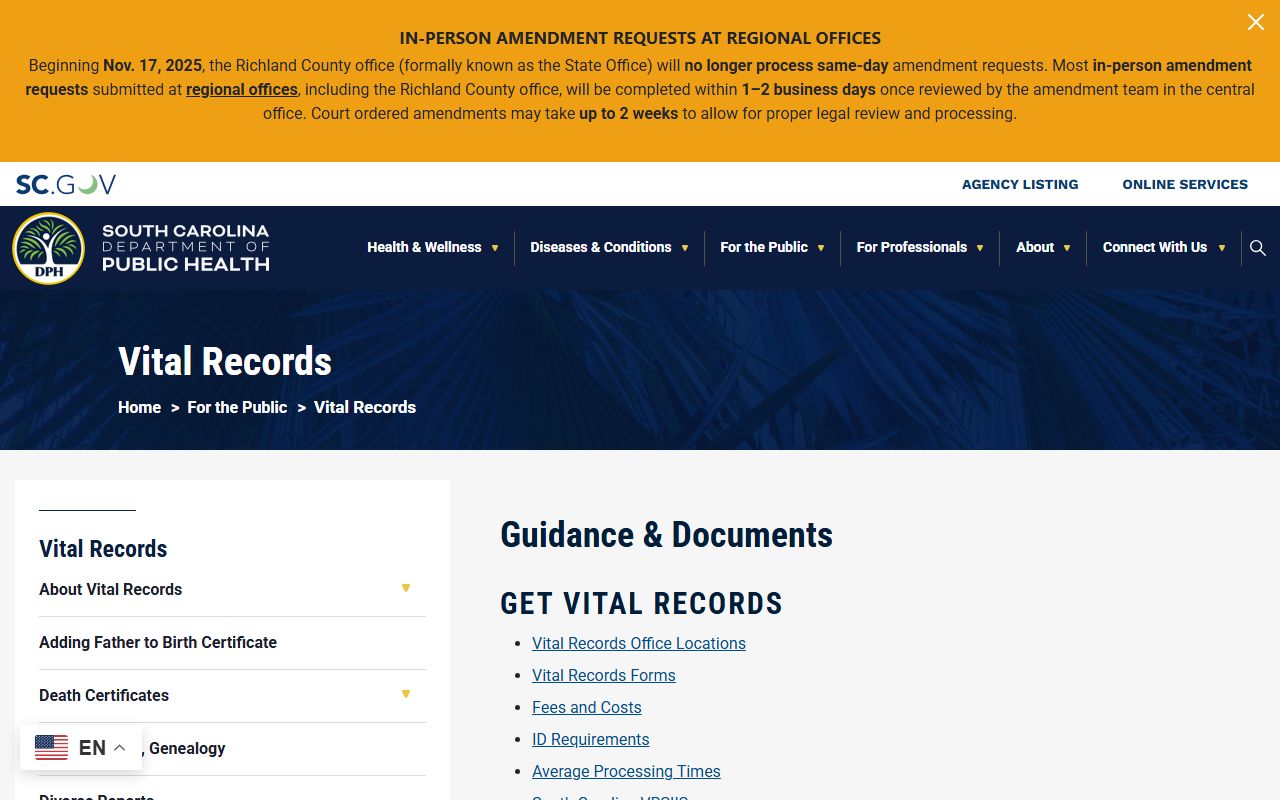
The Vital Records portal at SC DPH is the official starting point for ordering certified death certificates and accessing the South Carolina Death Index.
What South Carolina Death Certificates Contain
A South Carolina death certificate is a detailed legal document. It contains the full legal name of the deceased, date of birth, date of death, and place of death including the facility name and address when applicable. The certificate records the decedent's Social Security number, residence address, sex, race, marital status, and occupation. When a surviving spouse existed, that information appears on the record as well.
The medical certification section of a South Carolina death certificate is especially detailed. It lists the immediate cause of death, any contributing conditions, and the manner of death. Manner of death is classified as natural, accident, homicide, suicide, or undetermined. The certifying physician or medical examiner's name, license number, and signature all appear in this section. Funeral director information includes the funeral home name, address, and license number. Final disposition details cover whether burial, cremation, or another method was used and where it took place. Each certificate carries a unique state file number.
Effective July 23, 2019, South Carolina law was amended to allow Advanced Practice Registered Nurses to certify the manner and cause of death and sign death certificates. This change under Section 44-33-34 expanded who can legally complete death certification, which matters especially in rural parts of the state where a physician may not be immediately available.
The SC DPH death certificates information page describes the full contents and ordering process for death records.
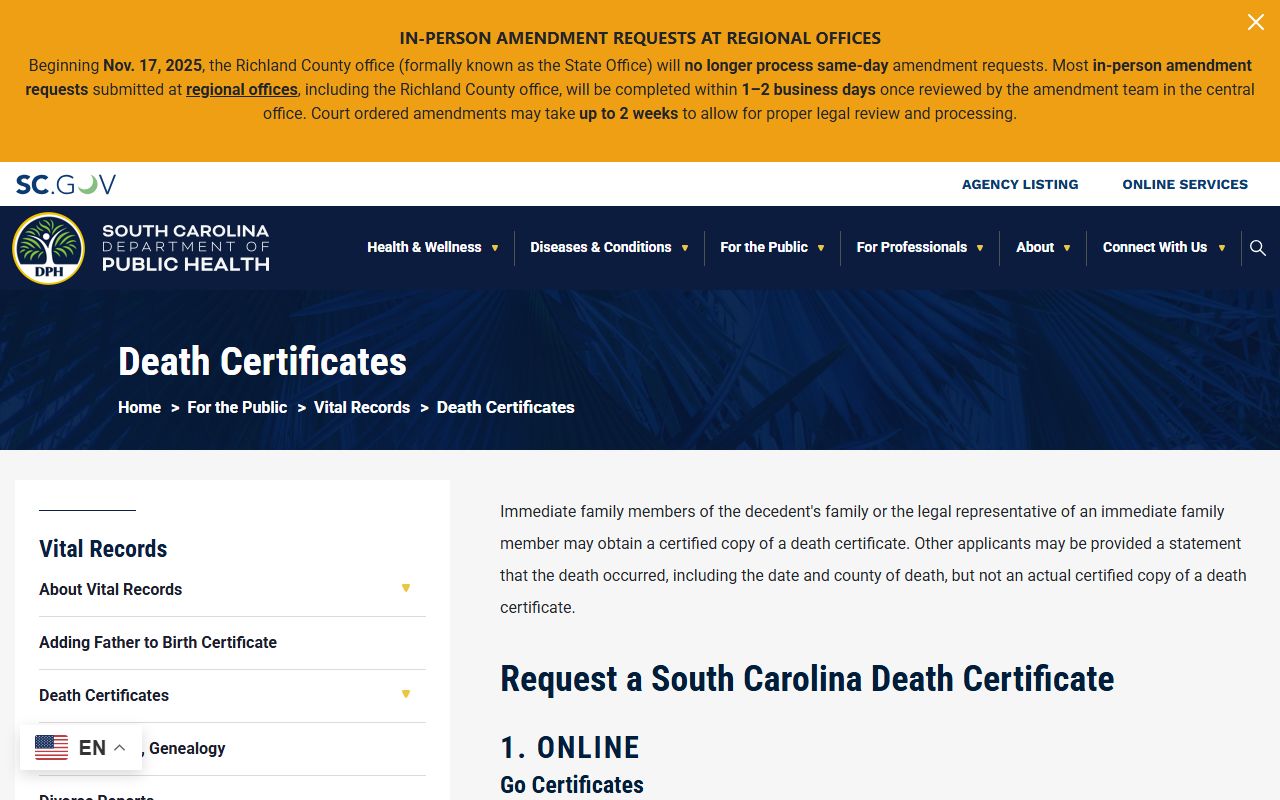
The death certificates information page at SC DPH explains what appears on a South Carolina death certificate and how to order one.
Note: South Carolina death certificates from the Vital Records office are certified legal documents. Genealogical copies from archives or index lookups are not suitable for legal purposes.
South Carolina Death Index Database 1915 to 1967
The South Carolina Death Indexes from 1915 to 1967 represent over five decades of statewide death registration. These records were digitized by the Division of Vital Records and made available as log files organized alphabetically by surname. The index uses a numeric coding system that researchers need to understand to read the entries correctly. For sex and race, the codes are: 1 for Male, 2 for Female, 3 for White, and 4 for Non-White. These codes reflect the historical record-keeping practices of the period.
The age coding system uses a three-digit format. The first digit indicates the unit of measurement: 5 for years, 6 for months, 7 for days, 8 for hours, and 9 for over 100 years. The last two digits give the actual number. For example, 535 means 35 years old. A code of 612 means 12 months, which equals one year old. A code of 715 indicates 15 days old. The code 800 denotes less than one hour old. This system covers all ages from newborns to centenarians without ambiguity.
The SC DPH maintains the database and provides access to the files at no charge. Researchers can browse the alphabetical listings within each year range to locate an entry. For common surnames, having the approximate county of death or age helps narrow results. Once you find the entry, record the state file number. That number goes on the request form when ordering the full death certificate.
The death indexes from 1915 to 1967 are available directly from the SC DPH website.
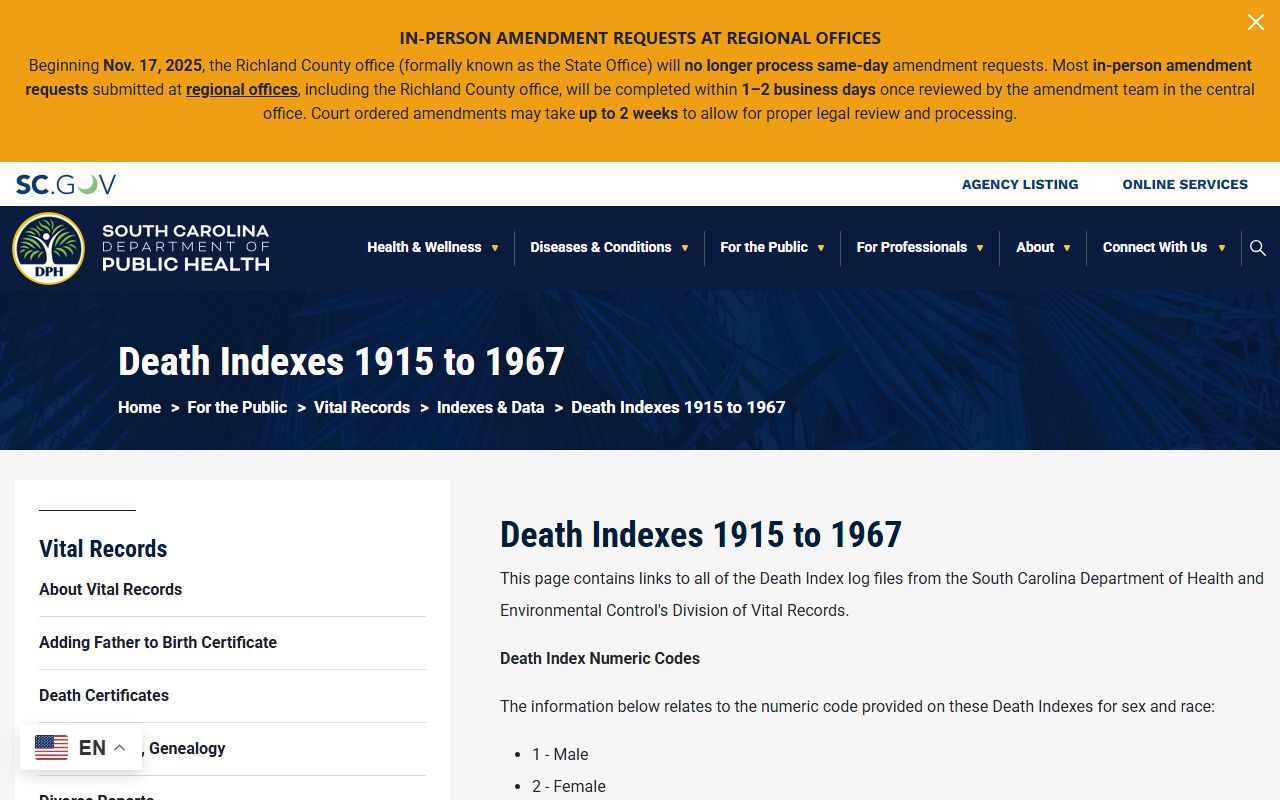
The 1915-1967 death index database at SC DPH is organized by year range and sorted alphabetically by surname for easy searching.
South Carolina Death Index for Genealogy Research
The SC DPH maintains a separate genealogy section of the death indexes that provides additional context and resources for family history researchers. This section explains how to link an index entry to the actual certificate, how to use the file numbers, and what resources are available beyond the state office. The genealogy death indexes connect researchers to both online tools and in-person collections.
The genealogy death index page references the South Carolina Department of Archives and History as a key resource for researchers. The Archives holds death records from 1915 through 1963 in microfilm format. The page also notes that image files are compressed in a format requiring current PDF reader software, and that some older cause-of-death codes use historical medical terminology no longer in standard use today.
The SC DPH genealogy page for death indexes provides guidance on linking index entries to actual certificate records.
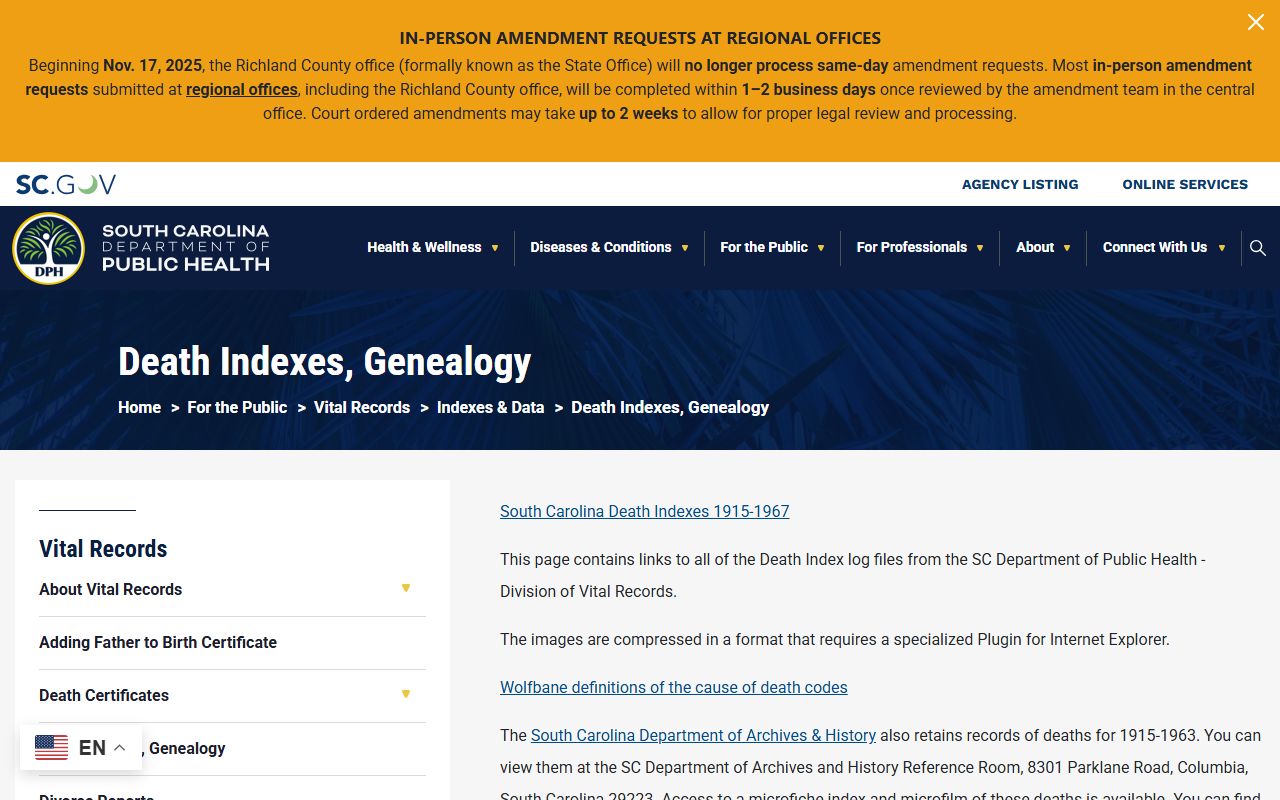
Genealogy researchers can use the SC DPH death indexes page to find state file numbers and then request full certificates from the appropriate office.
SC Department of Archives and Death Records
The South Carolina Department of Archives and History is an independent state agency that preserves documentary and cultural heritage spanning more than 350 years of South Carolina history. For death records researchers, the Archives is especially important because it holds death certificates from 1915 through 1963 on microfilm for in-person viewing. As of 2026, records through approximately 1975 fall within the public access period.
The Reference Room is located at 8301 Parklane Road, Columbia, SC 29223. The phone number is (803) 896-6100. Reference Room hours are Tuesday through Saturday from 8:30 a.m. to 5:00 p.m. The Archives is closed Sundays, Mondays, and state holidays. A microfiche index organized alphabetically by surname is available for searching. It shows the decedent's name, date of death, county, and state file number. Researchers can use this index to identify the microfilm reel needed for the full certificate image.
The Archives also maintains an online records index at archivesindex.sc.gov. This database lets you search the Archives' holdings before making the trip in person. The online index does not display actual document images but provides record series descriptions, box and folder numbers, and locating information. Beyond death certificates, the Archives holds county probate records including wills, inventories, and administrations that often contain death-related information for the period before statewide registration.
Reference room staff can assist with locating materials and using research facilities. Staff cannot conduct extensive research on behalf of patrons, but research guides and finding aids on the website help researchers identify relevant collections before visiting.
The SC Department of Archives and History holds one of the most comprehensive state archival collections in the nation.
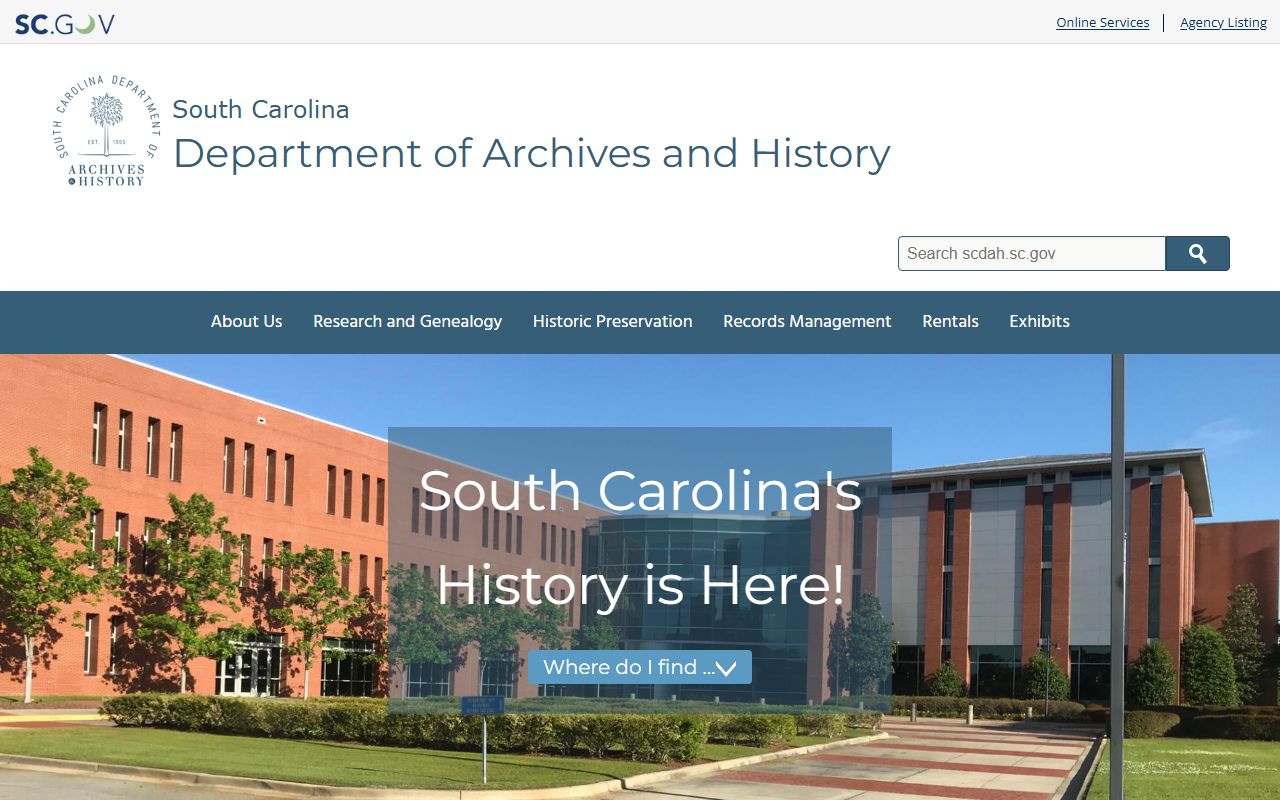
The SC Department of Archives and History provides in-person access to South Carolina death records from 1915 through the early 1970s on microfilm.
Death Record Access Restrictions in South Carolina
South Carolina applies a 50-year restriction to death certificates. Records less than 50 years old are not public records. They are restricted to immediate family members of the deceased, which includes the surviving spouse, parent, child, or sibling, as well as legal representatives of those individuals. This restriction is established under Section 44-63-84 of the South Carolina Code of Laws.
After 50 years from the date of death, the record becomes a public record. Any person may then obtain a copy by submitting an application with enough information to locate the record. Anyone requesting a vital record, whether family or public, must submit a photocopy of valid picture identification. Acceptable forms include a driver's license, state-issued identification card, passport, or military identification card.
Individuals who do not qualify for a full certified copy but have a legitimate reason for confirming a death occurred can receive a statement of death. This statement confirms the date and county of death only. It does not include the detailed personal, medical, and identification information on the full certificate. The statement serves purposes like property transfers, insurance claims, and other situations requiring confirmation of death without the full record.
Note: Anyone searching for a death record should confirm whether the 50-year period has passed before requesting a full certified copy, as this determines who is eligible to receive the complete certificate.
South Carolina Vital Records Laws and Statutes
Two sections of the South Carolina Code of Laws govern death records and death investigation. The first is Title 44, Chapter 63 - Vital Statistics, which establishes the legal framework for registration, certification, and access to all vital records including death certificates. The second is Title 17, Chapter 5 - Coroners and Medical Examiners, which covers death investigation procedures, coroner qualifications, and certification requirements.
Under Title 44, Chapter 63, Section 44-63-74 requires that death certificates be electronically filed with the Bureau of Vital Statistics within five days of the date of death. This requirement was added in 2015 and allows DPH to assess administrative penalties for late filings. The five-day window applies to funeral directors, physicians, coroners, and medical examiners. Section 44-63-110 establishes the fee authority for the Department to charge for record searches and certified copies.
The SC Vital Statistics Code Title 44 Chapter 63 is the primary legal authority governing death records in South Carolina.
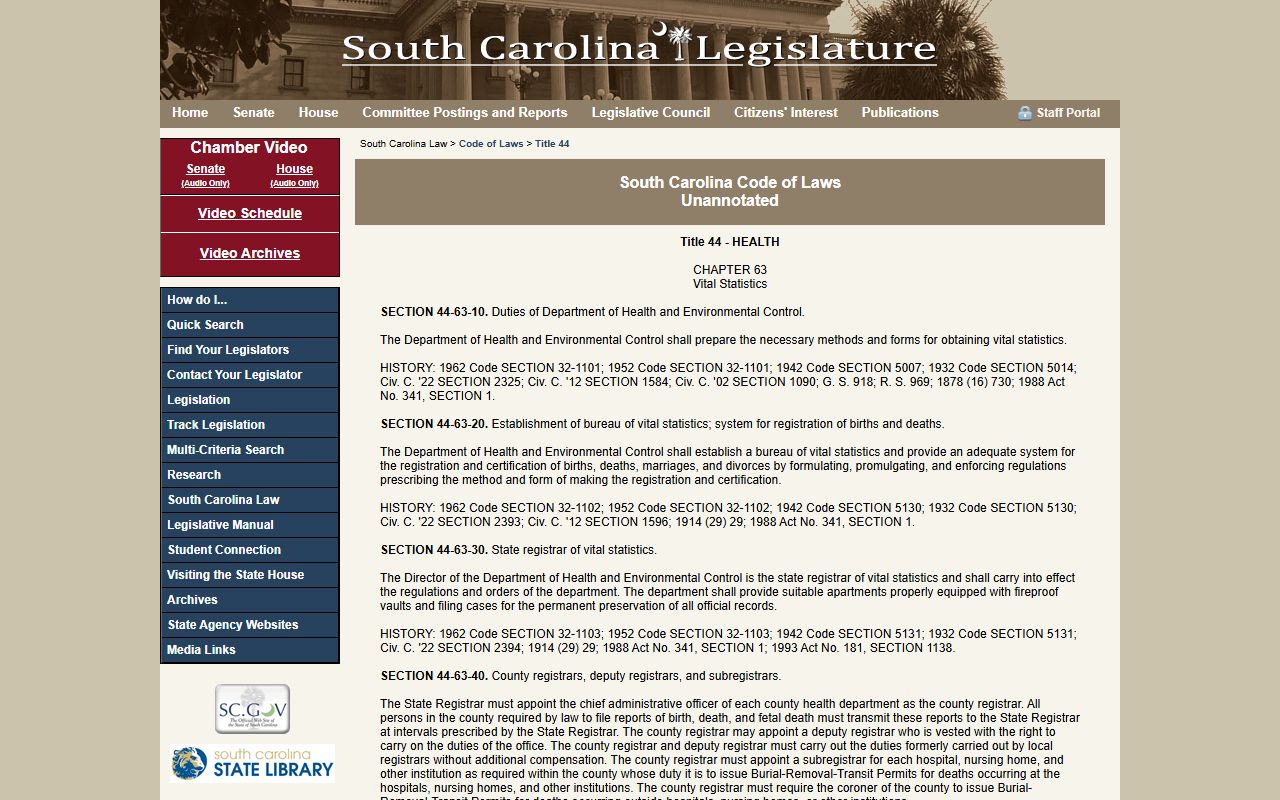
Title 44, Chapter 63 of the SC Code of Laws establishes the rules for death registration, access restrictions, and fee authority for vital records in South Carolina.
Under Title 17, Chapter 5, Section 17-5-530 lists the types of deaths that must be reported to the coroner. These include deaths from violence, apparent suicides, deaths of people in apparent good health, deaths unattended by a physician, deaths in suspicious or unusual circumstances, inmate deaths, and deaths in healthcare facilities within 24 hours of admission. Section 17-5-560 requires coroners to complete medical certification of cause of death within 24 hours of notification.
The SC Coroners Code Title 17 Chapter 5 covers death investigation procedures and coroner responsibilities across all 46 South Carolina counties.
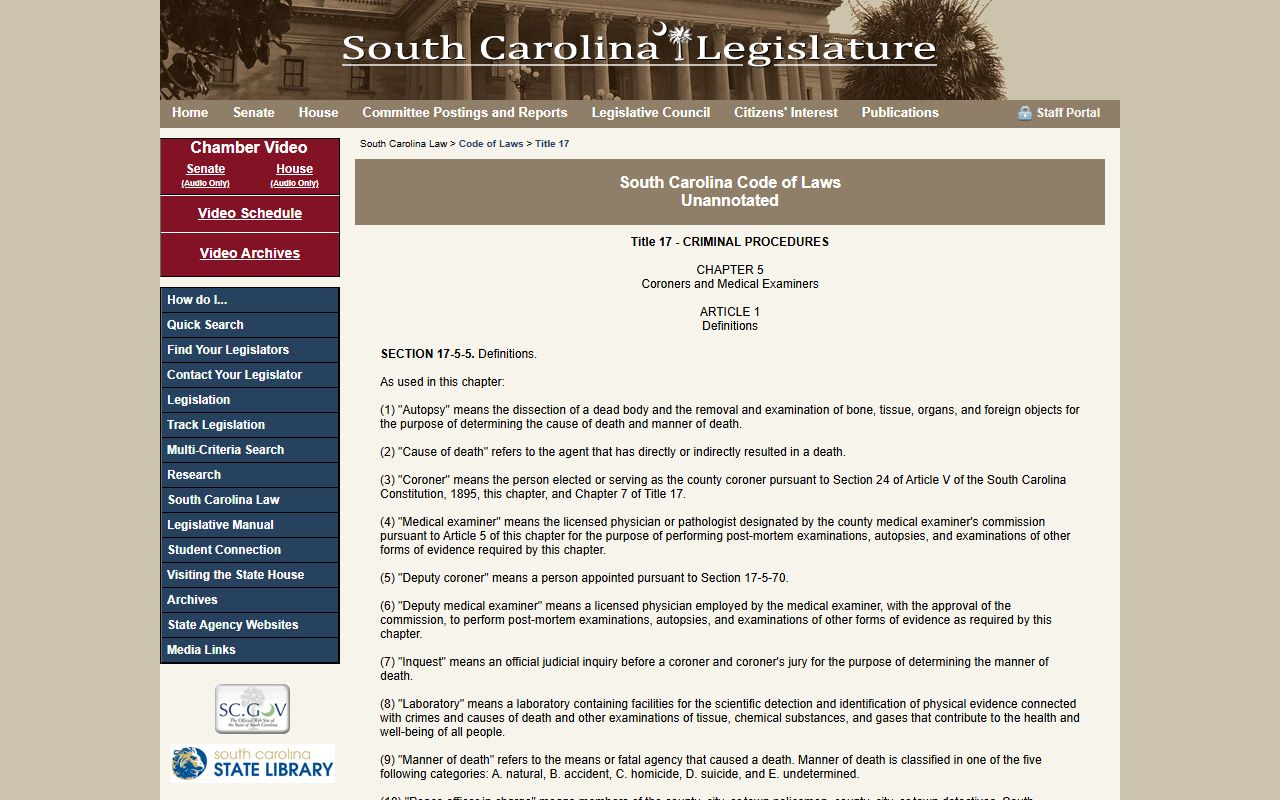
Title 17, Chapter 5 governs coroner and medical examiner duties, including which deaths require investigation and how death certification is completed in South Carolina.
South Carolina Coroner System and Death Investigation
South Carolina uses an elected coroner system. Every one of the 46 counties elects its own coroner rather than appointing a medical examiner as some other states do. Under Section 17-5-130, to qualify as coroner a person must be a U.S. citizen, a county resident for at least one year before election, a registered voter, at least 21 years old, hold a high school diploma or equivalent, and have no felony convictions. Training and continuing education requirements apply to all coroners.
Coroners are responsible for investigating deaths that fall under the categories listed in Section 17-5-530. When a death requires investigation, the coroner must issue a burial-removal-transit permit before the body can be moved. This permit system creates a documentation trail for deaths under coroner jurisdiction. When the final cause of death cannot be immediately determined, the coroner may list "pending investigation" on the certificate and amend it once all testing is complete.
Section 17-5-540 requires coroners to notify the Department of Child Fatalities within 24 hours when a child dies, supporting the state's child death review process. This review process aims to identify preventable causes of child mortality and recommend systemic improvements. Coroner records generated through these investigations may eventually feed into the death index and certificate system.
VRSIIS Electronic Death Registration System
South Carolina uses the Vital Records and Statistics Integrated Information System, known as VRSIIS, for electronic death registration. This system replaced older paper-based processes and provides electronic filing for funeral directors, physicians, coroners, and medical examiners. The system includes built-in validation to reduce errors, interfaces with the Social Security Administration for death reporting, and maintains a complete audit trail of all entries and changes.
Electronic signatures are accepted for death certification through VRSIIS. This streamlines the process while maintaining legal validity. The system also includes COVID-19 reporting requirements, directing certifiers to include COVID-19 in the chain of causation when appropriate following CDC guidance. Access to VRSIIS is restricted to authorized users. Training is required before system access is granted. For access requests, contact VRSIIShelpdesk@dph.sc.gov. Technical support is available at 1-866-489-8477.
The VRSIIS system overview page at SC DPH describes the electronic death registration process and how it supports accurate and timely vital records filing.
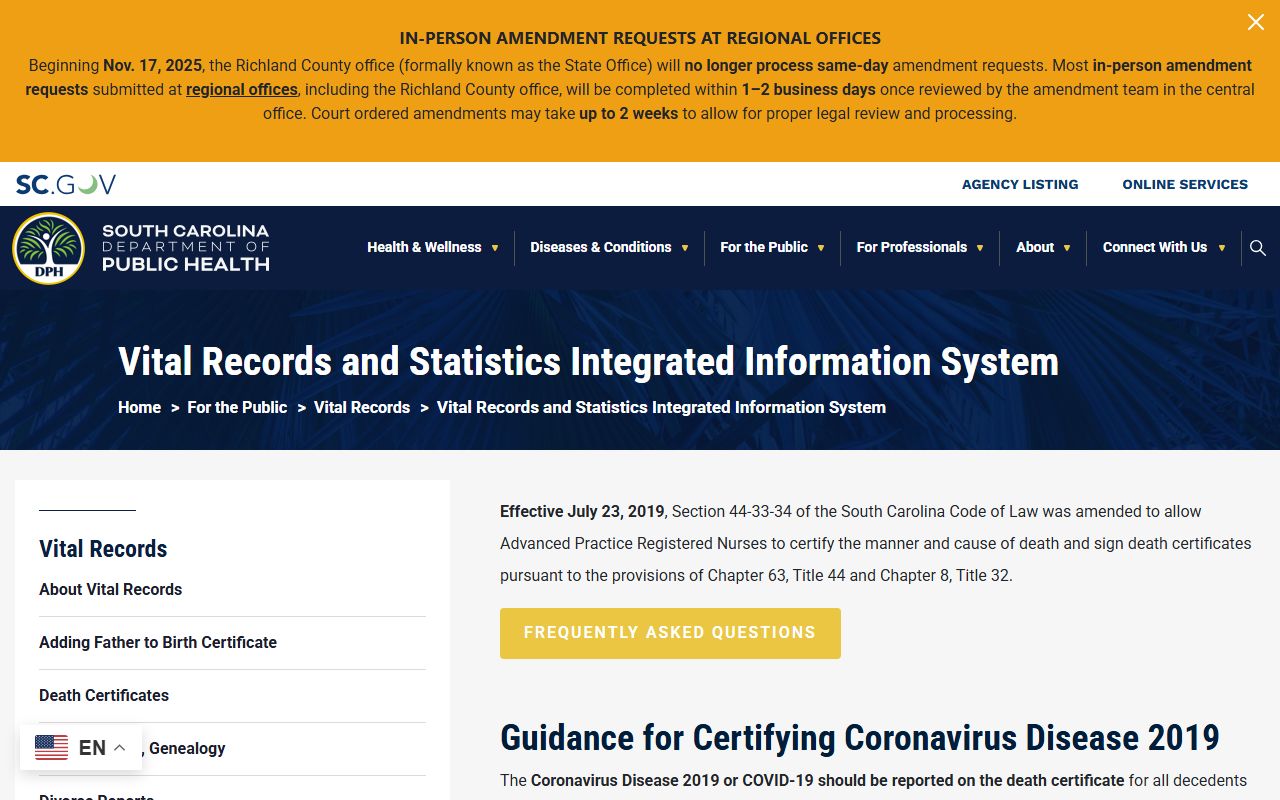
VRSIIS is the electronic backbone of South Carolina death registration, ensuring that death certificates are filed within the five-day window required by state law.
Online Death Records and Genealogy Resources
Several free online resources complement the official state death index. The FamilySearch South Carolina vital records collections include South Carolina Deaths 1915-1973 with index and images, South Carolina Deaths and Burials 1816-1990 as an index, and South Carolina Death Records 1821-1972. These collections provide free access to digitized death records and are particularly useful for genealogical research because they include some records predating statewide registration. FamilySearch's collections are not certified copies and are not suitable for legal use, but they are excellent for family history work.
The Ancestor Hunt maintains a comprehensive directory of free online South Carolina death records organized by county. The site links to the statewide 1915-1967 death index, South Carolina Death Certificates 1915-1963, and county-specific collections. Historical coroner's inquest records are also accessible through this resource for counties where they have been digitized. The site focuses on free resources, making it useful for researchers who do not subscribe to commercial databases.
The Library of Congress Research Guide for South Carolina Local History and Genealogy provides a federal-level reference for vital records research. The guide confirms statewide death registration from 1915 forward, notes the Charleston (1821) and Georgetown (1883) exceptions, and provides additional context for understanding the state's record-keeping history. As a federal resource, the Library of Congress guide is reliable for citing in research.
The Library of Congress vital records research guide for South Carolina provides authoritative guidance for genealogists searching death records.
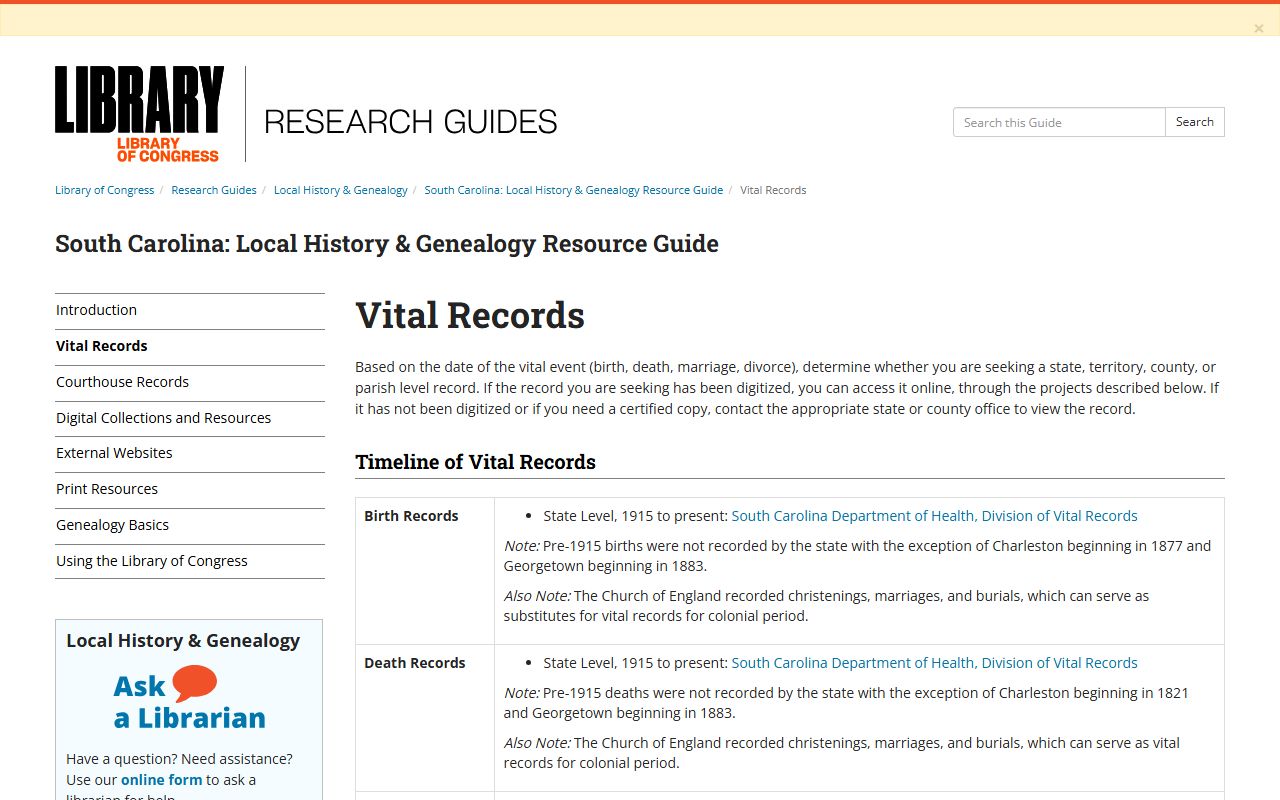
The Library of Congress research guide confirms key facts about South Carolina death records and directs researchers to both state and federal sources.
The Ancestor Hunt provides one of the most complete directories of free South Carolina death records available online.
The Ancestor Hunt compiles free South Carolina death record links organized by county, giving researchers a single starting point for finding county-level death indexes.
The CDC vital records guidance page for South Carolina confirms office details and access requirements for death certificate requests.
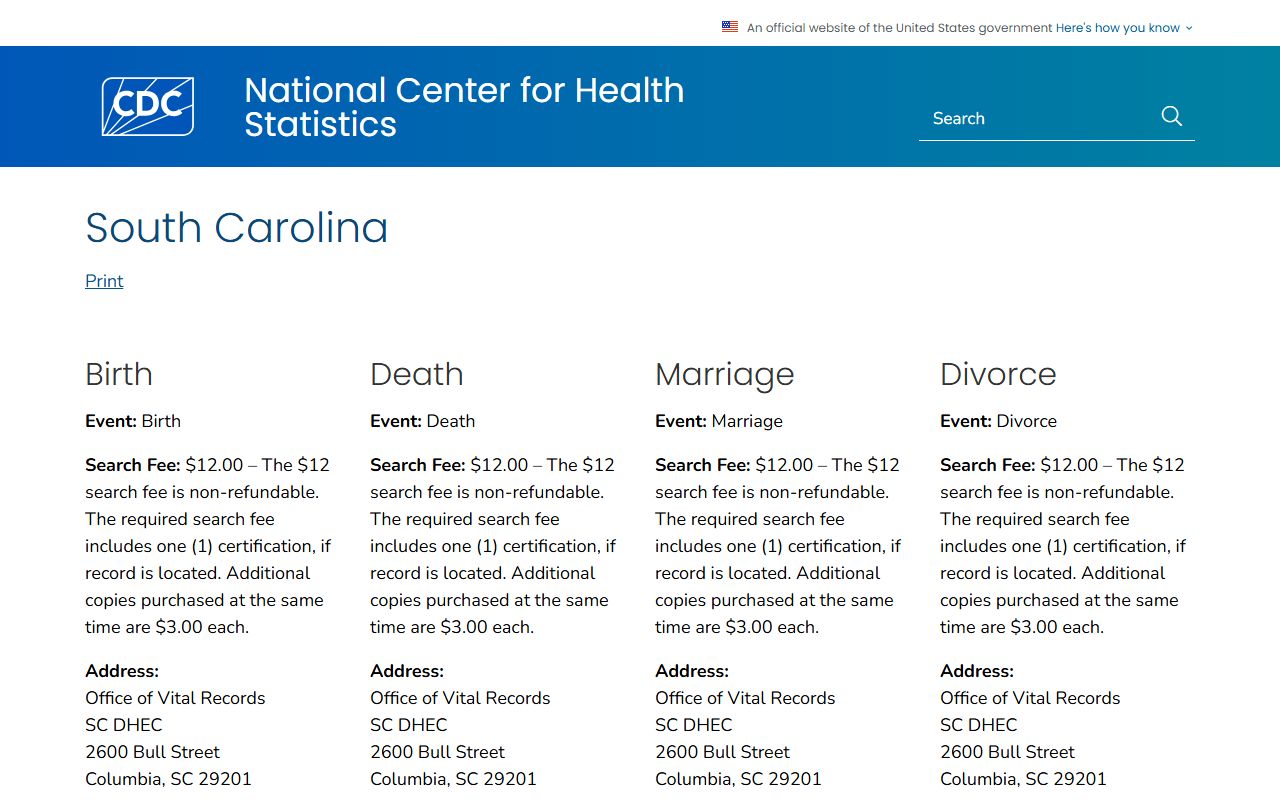
The CDC National Center for Health Statistics guidance page for South Carolina serves as a federal verification of state office contact information and fee structure.
Browse South Carolina Death Index by County
South Carolina has 46 counties, each served by an elected coroner who handles death investigations in that jurisdiction. Select a county below to find death record resources, coroner contact information, and local vital records guidance.
South Carolina Death Records by City
Death records for residents of South Carolina cities are filed through the county coroner and held by the state vital records office. Select a city below to find death record resources for that area.